

Table of contents
 Make Resume Now a preferred source on Google
Fast Facts
- A CV is a comprehensive document providing a detailed account of your entire academic and professional journey, including publications, research, and teaching experience.
- While often interchangeable globally, in the U.S., resumes are standard for most jobs, whereas CVs are specifically required for academia, medicine, research, and law.
- A well-written CV must include contact information, a professional summary, skills, education, work experience, and optional specialized sections like awards or certifications.
While resumes are standard for many roles, careers in academia, medicine, and law often require a comprehensive CV. Learning how to write a CV ensures you effectively showcase your full academic and professional background.
This guide provides a streamlined, step-by-step approach to mastering the CV. You'll learn how to choose a strategic layout and articulate your expertise to command attention from hiring managers.
Want to create your CV faster? Our AI CV Maker generates tailored content based on your experience and automatically formats each section into a polished, professional document.
What Is a CV?
A CV, or curriculum vitae, is a comprehensive document that outlines your academic background, work experience, skills, achievements, and professional history.
The term "curriculum vitae" comes from Latin, meaning "course of life," and that's exactly what it represents—a detailed account of your professional journey.
A CV may include sections such as education, publications, research experience, certifications, awards, teaching experience, and professional affiliations.
The main difference between a CV and a resume is that a CV is more detailed and often used in academic, research, or international job applications, where a full record of your credentials is expected.
The word "CV" also has different meanings depending on where you live. In Europe, a CV is the same as a resume. In the U.S., a CV is typically used for academic, medical, or research roles.
Understanding this difference is important when learning how to make a CV for different job markets.
Need a resume instead? Our AI Resume Builder will help you create a job-winning resume in minutes.
What to Include in a CV
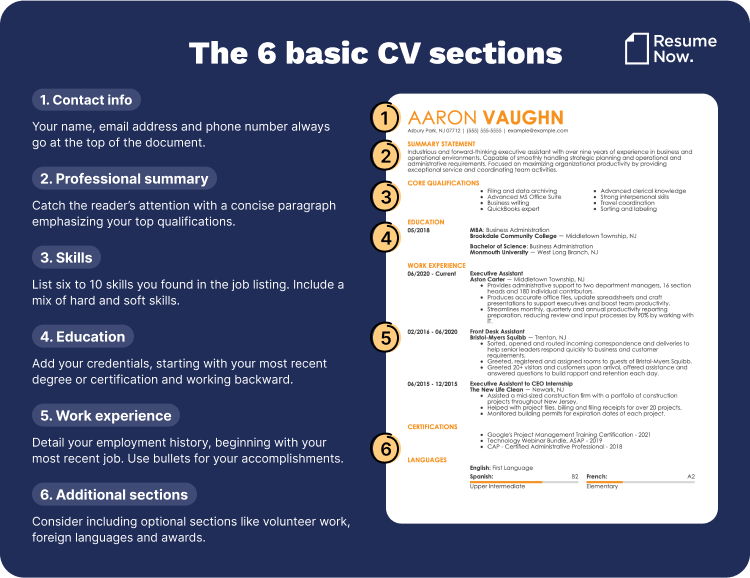
A CV should include a complete record of your academic and professional history, with enough detail to showcase your qualifications, achievements, and expertise.
Every CV should include:
- Contact information
- Professional summary
- Skills
- Education and relevant certifications
- Work experience
- Additional sections, such as publications or research, languages, and awards
How to Write a CV for a Job Application: 7 Steps
To write a CV for a job application, you need a clear, structured document that presents your full professional and academic history while highlighting your most relevant experience.
These seven basic steps will show you how to write a CV for job application success:
Step 1
Choose a CV Template
Start by choosing a professional, ATS-friendly CV template. A clean layout helps employers quickly find your qualifications while ensuring applicant tracking systems (ATS) can accurately scan your information.
Whether you're learning how to make a CV for creative or corporate roles, templates matter. Here are three template types we offer:
- Creative templates: Great for showing off your personality in a field like graphic design, architecture, or photography
- Modern templates: An excellent choice for emphasizing your credentials in various industries
- Simple templates: Offer a pared-down approach ideal for industries like construction and logistics
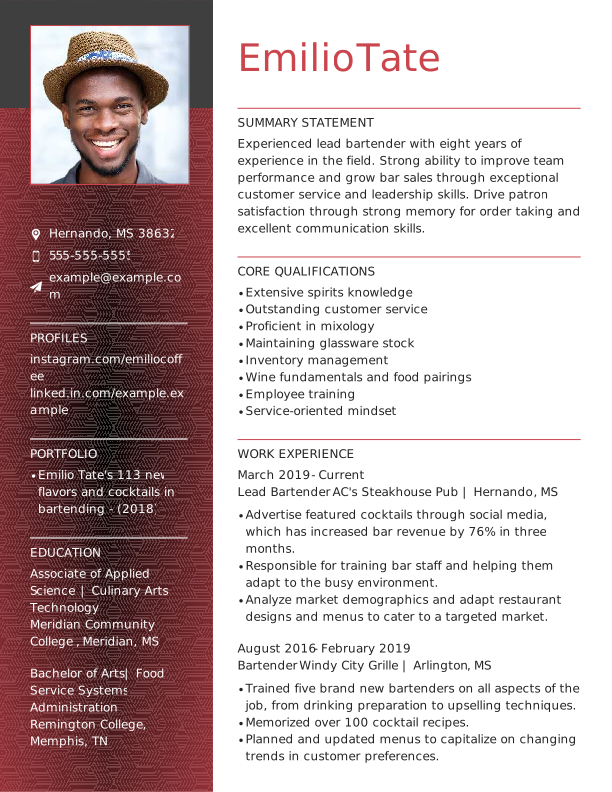
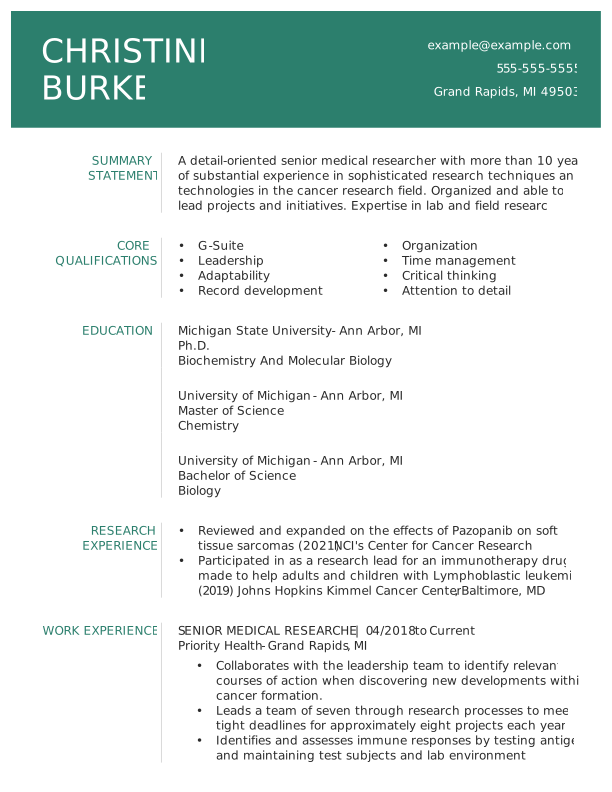
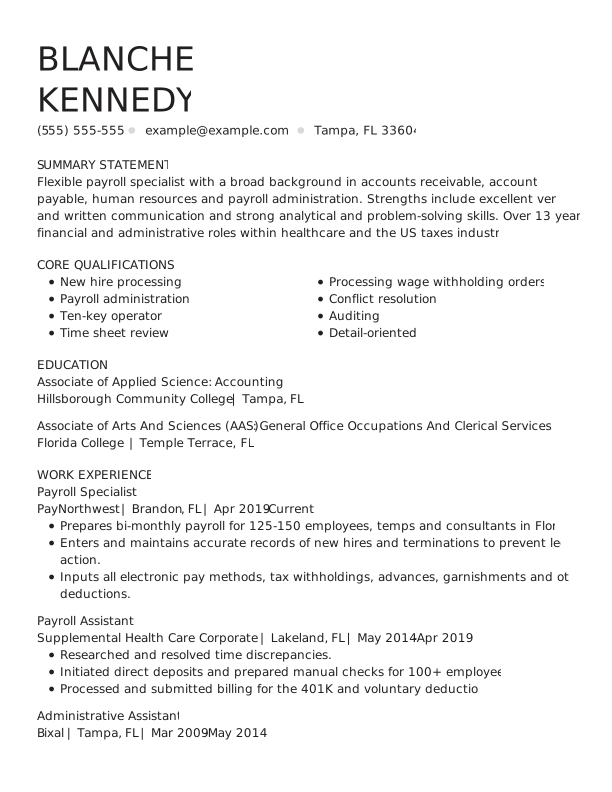
Here are three popular options from our CV template library:
Not sure if your CV is ATS-ready? Try our ATS Resume Checker for a free ATS report in just seconds. Upload your CV, get your score, and improve your document so you can submit with confidence, knowing your CV is optimized to pass screening and reach recruiters.
Step 2
Add Your Contact Information
Your contact info should always be in the header at the top of your CV—either at the left, right, or center. While the exact location depends on your CV template, your header should always include your full name, location, phone number, and email address.
Feel free to include your LinkedIn profile, a portfolio site, or professional social media handles if you have any.
Here's an overview of what to include and what to leave out of your header:
- First and last name
- City and state (zip code optional)
- Phone number
- Email address
- Zodiac sign
- Date of birth
- Unprofessional email address
- Political or religious affiliations
- Nationality
CV headers vary in style. Here's an example of two different header styles:
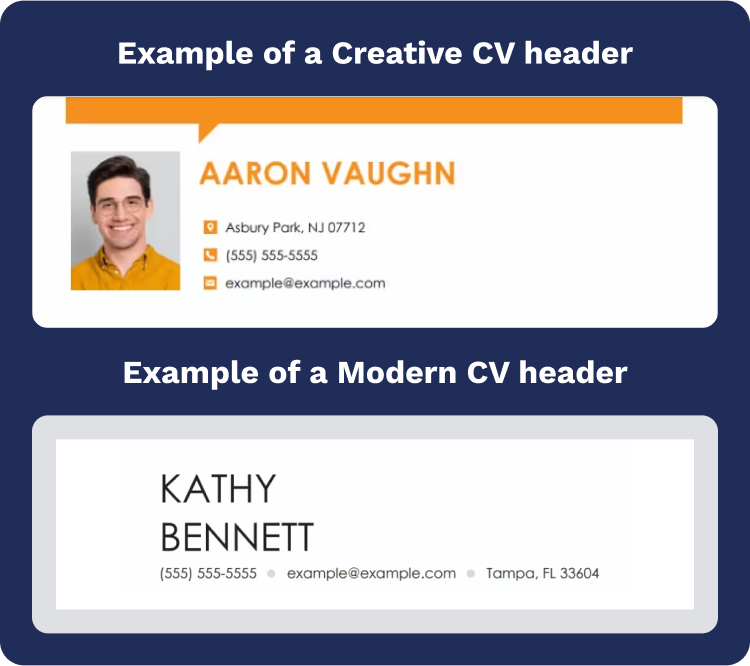
Both headers include the same essential contact information, but they organize it differently. One uses a centered layout to emphasize your name, while the other places contact details beside your name for a more traditional, space-efficient design.
Step 3
Write an Impressive Summary Statement
Write a three- to five-sentence professional summary that highlights your experience, strongest qualifications, and career goals. This is one of the most important parts of CV writing because it determines whether recruiters keep reading.
Excellent summaries, whether professional summaries or objective statements, are focused, brief, and full of relevant keywords that show how well-suited you are to the role. They also use action words to keep the recruiter engaged.
If you're unsure of which words to use, the job listing can be your guide. Highlight any job-specific keywords, and include them in your summary statement if the skills accurately represent your experience.
The following examples demonstrate how to write a good CV summary statement:
Lawyer Summary Statement
Dedicated and results-driven attorney with 11 years of experience in intellectual property law. Adept at providing strategic legal advice and representation to clients while ensuring compliance with relevant laws and regulations. Proven track record of successfully managing complex legal matters from inception to resolution.
Nursing Assistant Summary Statement
Energetic nursing student seeking a nursing assistant role at a private clinic. Dedicated to delivering high-quality, patient-centered care and navigating complex healthcare environments efficiently. Committed to applying strong clinical fundamentals to support the nursing team and improve patient outcomes.
College Professor Summary Statement
Passionate and accomplished mathematics professor with a proven track record of fostering an engaging learning environment and facilitating student success. Bringing 15 years of experience in instilling a love for mathematics and cultivating critical thinking skills. Adept at developing and delivering innovative curricula and committed to creating a positive and inclusive educational experience.
Pro Tip
For help writing your summary statement, try our free AI Summary Generator. Simply upload your resume, and our tool will create a summary based on your experience in seconds.
Step 4
List Your Relevant Work Experience
List your work experience in reverse-chronological order, starting with your most recent position. Include your job title, employer, location, and dates of employment for each role.
Under each position, use bullet points to highlight accomplishments rather than everyday responsibilities. Whenever possible, include measurable results, such as percentages, revenue, project outcomes, or team size, to demonstrate your impact.
Before you write, review your job history and identify your strongest achievements. Prioritize examples that are most relevant to the role you're applying for.
Here are examples of effective CV work experience sections for three different industries:
Work Experience Sample for a Teaching Assistant
Teaching Assistant | Jan 2021–March 2026
Purchase College, SUNY – Purchase, NY
- Collaborated with lead instructors in the History department to facilitate an interactive and inclusive learning environment for 126 undergraduate History majors.
- Provided individualized support to 10 to 20 students during office hours, addressing questions, clarifying concepts, and offering guidance on assignments.
- Graded hundreds of assignments, exams, and other assessments with attention to detail, ensuring accuracy and consistency in evaluation.
- Utilized educational technology tools to enhance students' learning experience and support remote learning initiatives.
- Introduced engagement strategies that increased classroom participation and student interest by 25%, contributing to stronger overall academic outcomes.
Work Experience Sample for a Civil Engineer
Civil Engineer | Jan 2024–Present
Moody Engineering LLC – Elmhurst, NY
- Respond to emergency sewer requests on a 24-hour basis and determine the most cost-effective repair method.
- Evaluate more than 300 sites per year as part of a collaborative team, including a biologist and a demographics expert.
- Manage project budgets ranging from $5M to $15M, maintaining cost control and financial accountability across all phases.
- Implemented sustainable engineering practices that reduced environmental impact by 7%, supporting environmentally responsible project outcomes.
Work Experience Sample for a Journalist
Senior Journalist | Sep 2020–Jan 2026
Tallahassee Tribune – Tallahassee, FL
- Spearheaded investigative reporting, producing five in-depth articles on the police beat.
- Led a team of 10 reporters, providing editorial guidance, assigning stories, and ensuring adherence to tight deadlines while maintaining the highest standards of journalistic integrity.
- Cultivated and maintained relationships with key sources, experts, and community leaders to stay abreast of emerging trends, breaking news, and exclusive story opportunities.
- Awarded the Society of Professional Journalists honor for an investigative report on police corruption, recognizing excellence in reporting and impact.
- Applied data journalism techniques to translate complex crime statistics into clear, accessible stories, improving reader understanding and engagement.
Step 5
Add Relevant Skills for the Role
Include skills that match the job description, including both technical abilities and workplace skills such as communication, leadership, and problem-solving when they're relevant to the role.
While this section doesn't involve much writing, it does require thoughtful preparation. You need a mix of hard and soft skills, so read the job description closely to see what the employer is looking for.
If you're changing careers, prioritize transferable skills—such as communication, leadership, project management, or problem-solving—that demonstrate your ability to succeed in a new role.
Highlight the skills that apply to you, then naturally work them into your CV.
Example Skills for a Payroll Specialist
vs
Example Skills for an Executive Assistant
- Payroll software proficiency
- Tax compliance
- Mathematical aptitude
- Attention to detail
- Time management
- Data entry
- Recordkeeping
- Regulatory knowledge
- Administrative support
- Time management
- Problem-solving
- Calendar management
- Communication
- Discretion
- Travel coordination
- Event planning
Pro Tip
Not sure which skills to include in your CV? Our AI Skills Generator can help. This free tool offers a list of skills based on your job title. Just copy and paste—and get ready to make a strong impression.
Step 6
Build Your CV Education Section
Your education section should be cleanly formatted and relevant to the job you're applying for.
Whether you're learning how to write a CV for grad school, a research assistant job, or anything in between, there are a few key rules to follow:
- Keep your entries uniform.
- Only list high school if it's your highest level of education.
- Only add graduation dates to your CV if you're a very recent graduate.
Check out these examples of how to craft this section for different levels of education:
College Graduate
Bachelor of Arts, Journalism
College of Communication & Information | Tallahassee, FL | June 2025
Advanced Degrees
PhD in Biochemistry and Molecular Biology
Michigan State University | East Lansing, MI
Master of Science in Chemistry
University of Michigan | Ann Arbor, MI
Bachelor of Science in Biology
University of Michigan | Ann Arbor, MI
Step 7
Include Additional CV Sections
While a standard CV will always include the same core sections, optional sections include:
- Certifications: Professional certificates you've earned through classes or tests
- Awards: Notable awards or honors you've received for outstanding work, including grants and scholarships
- Languages: Any languages you know, including your fluency level (e.g., novice, intermediate, expert)
- Publications: Relevant articles you've written that have been published in a journal, online publication, or book
- Hobbies and interests: Subjects of knowledge and enthusiasm related to your work
- Conference attendance: Any relevant conferences and sessions you've attended
- Membership affiliations: Being a member of a relevant club or professional association
- Projects: Relevant projects you've completed, whether for a course, a job, or for personal reasons
- Licenses: Licenses or permits related to the practice of your profession
- Teaching experience: Teaching experience to get jobs in education and academia
For example, here's how you might list certifications in a separate section on your CV:
Certifications & Licenses
- American Board of Pediatrics (ABP) certification
- Pediatric Advanced Life Support (PALS) certification
- California State Medical License
How to Take Your CV to the Next Level
Taking your CV to the next level means improving clarity, strategically tailoring your content, and showcasing measurable results. Follow these tips to polish your document before sending it out into the world:
- Customize Your CV for Every Job
Tailoring your CV to each job is essential. Carefully read the job description, highlight relevant skills, and include them in your CV. You can also reference the employer's mission in your professional summary. Hiring managers like applicants who research the company and understand its mission before they apply. It shows them that you're serious about the job. - Make It Visually Appealing
Your CV should be well-organized with thoughtful, consistent use of white space and fonts. Small elements of color or design may be appropriate, but your priority should always be legibility and structure over style. Unless you're a designer, it's usually best to start with a professionally designed template. - Focus on Measurable Results
Numbers tell a story, so your CV should focus on the measurable impact of your work. Quantifying your achievements helps employers quickly understand your capabilities and the value you delivered. For example, instead of writing, "Addressed customer needs on the sales floor," write, "Assisted 30+ customers per day, achieving a 98% customer satisfaction rate over three years." - Be as Specific as Possible
Be specific about your achievements—broad statements won't set you apart. Instead of saying you "oversaw projects," name the exact project and explain its impact on the company. Specific, concise accomplishments give hiring managers a clearer understanding of your contributions and help you stand out from other candidates. - Proofread Carefully
Proofread your CV thoroughly to ensure it's free of errors and reflects professionalism. Small mistakes can undermine your credibility, so review your document several times and read it aloud to catch awkward phrasing or simple errors. For an extra layer of quality control, ask a friend, mentor, or former colleague to review it before you apply.
5 Common CV Mistakes to Avoid
Before you submit your application, take a moment to review these common CV mistakes and learn how to avoid them so your experience can shine.
Mistake #1: Writing a Generic CV
Every CV you write should be customized for the job. When you turn in a generic CV, the HR manager can tell you didn't read the job listing. Worse, you could get screened out by the employer's ATS software for not using the right keywords.
How do you avoid being generic? Read the job description carefully and ensure your CV highlights the skills and qualifications required for the role.
Mistake #2: Focusing on Job Duties Rather Than Achievements
The bullet points in your work experience section should show your impact, such as whether you generated more sales, revenue, or positive reviews.
A good rule of thumb is to ensure that every bullet point begins with an active verb and features a measurable outcome you achieved or a challenge you overcame.
Mistake #3: Including Irrelevant Information
While it's great that you managed to pull in extra money with a side hustle, your next employer may not find this information helpful.
Always ask yourself, "Is this relevant to the job I want?"
For example, if you work as a bank teller and want to climb to a higher position, you can leave your gig driving for Uber off your CV.
Mistake #4: Failing to Focus on the Employer's Needs
Employers want to hire people who will help them achieve their goals. A strong CV isn't just about you—it's about alignment with the role.
Before writing your CV, read and understand the employer's mission statement, and ensure your CV addresses it. Your professional summary is a strong place to reflect this alignment.
Mistake #5: Using an Unprofessional Email Address
Never use an informal email address like "xStoneColdx@example.com," which can undermine your credibility instantly.
A professional email address should use a simple combination of your name or initials, such as "johndoe@example.com" or "msmith@example.com."
Well-Written CV Examples
Review these CV examples to see how successful documents are organized and written.
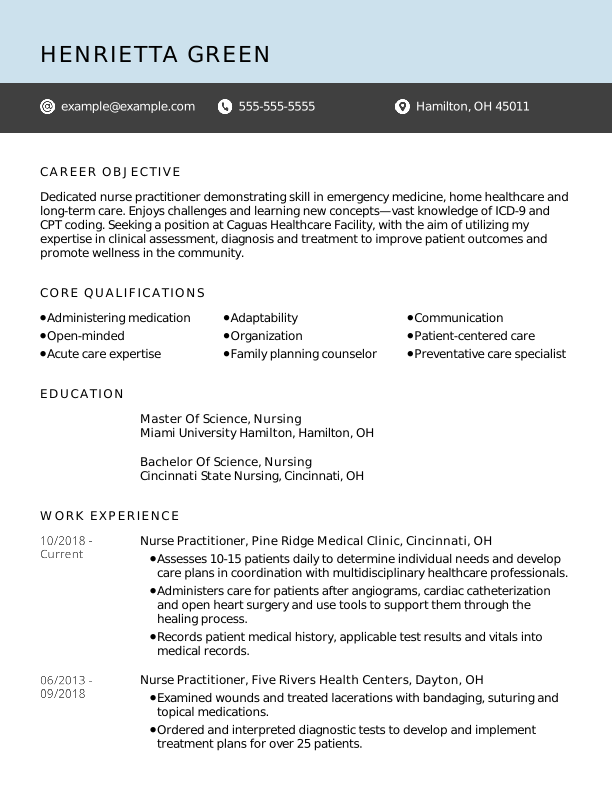
CV Example for a Job Application
The example below is for a standard CV you'd submit for a typical job.
CV Example for Grad School
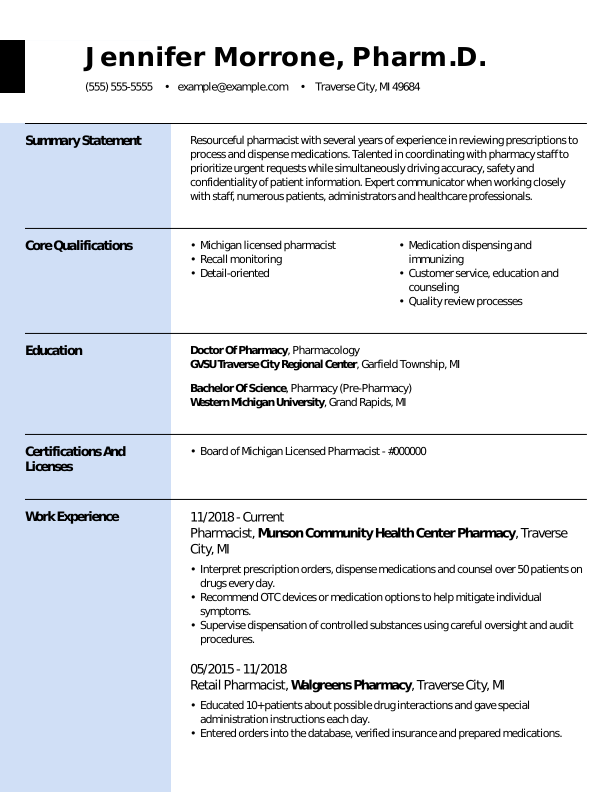
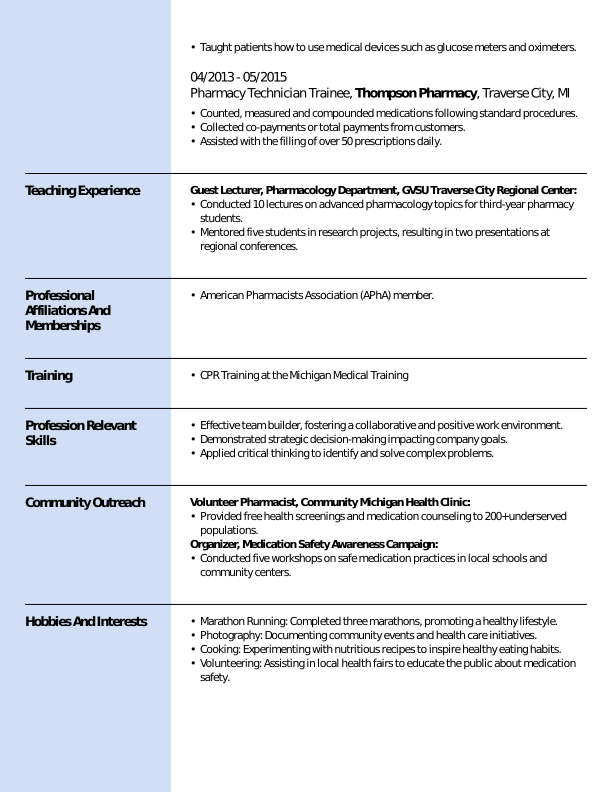
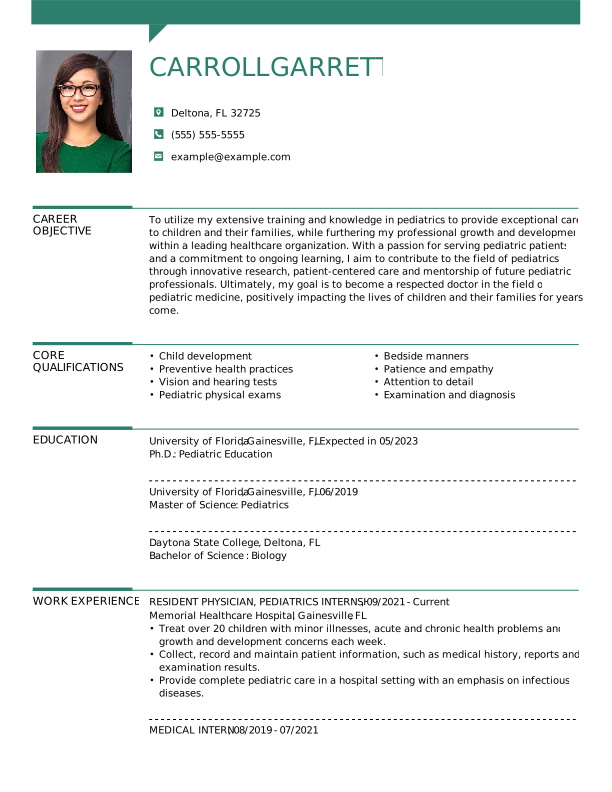
A grad school CV is usually two or more pages long and includes a more extensive history of your academic and professional achievements. Optional sections include teaching experience, publications, and conferences attended.
The below example shows the first page:
Is My CV Ready to Submit?
You should double-check your CV to ensure that it's optimized to make a strong impression before you submit it. This checklist will help you confirm that your CV is complete, consistent, and ready for employers.
- Ensure You've Included the Essential CV Sections
These include your contact info in the header, a professional summary or objective, a skills section, work experience, and education. This is a core requirement to meet employer expectations. - Consider Whether You've Chosen the Right Template
A plain template will get the job done if you work in a more traditional industry. If you're in a creative field, you may want to explore templates that express your individuality. Your template should fit both your industry and role. - Double-Check Your Formatting
Did you choose a professional font? Is your line spacing consistent? Are your headers the same font size? Clean formatting is essential because it affects readability and ATS performance. - Make Sure Your Summary Is Relevant to the Role
Your CV summary should always be enthusiastic and specific. Focus on the skills and abilities the employer cares about, as your summary often shapes your first impression. - Review Your Work Experience for Measurable Results
Your bullet points should do more than list job duties—they should show impact. Use concrete numbers whenever possible. This is a defining feature of how to write a good CV that stands out. - Compare the Job Description to Your Skills Section
Cross-reference your skills with the responsibilities the employer listed in the job description. These are often the same keywords used in their screening software. Aligning your skills section is essential for modern hiring systems. - Proofread Your CV at Least Twice
Spelling and grammar mistakes are one of the main reasons CVs get rejected. Proofread your CV multiple times, then have a trusted friend review it. Attention to detail is a core part of writing a successful CV.
How to Make a CV With Our Builder
Our CV builder takes the pain out of making a well-written, custom CV. Simply follow these steps to create an impressive CV in just minutes:
Select a Template
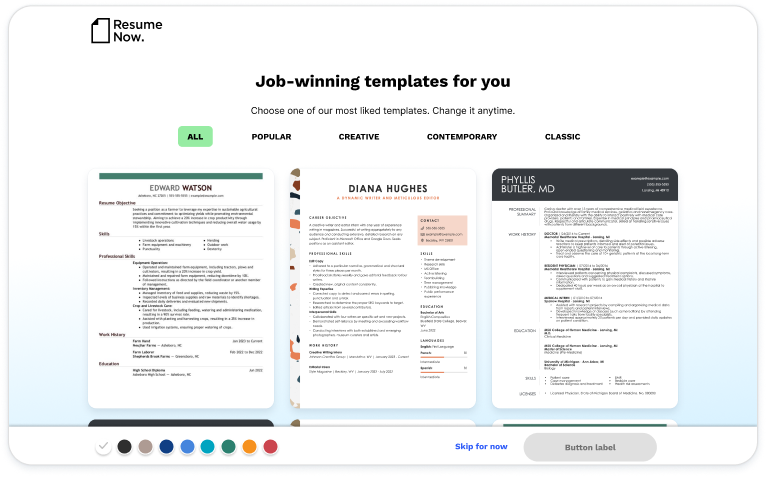
Choose from dozens of CV designs ranging from colorful and creative to simple and professional.

Tell Us About Yourself
Add your contact information and desired job title to start getting job-specific suggested CV content.
Get Section-by-Section Advice
Follow the prompts and choose whether to apply content suggestions and advice as you go.
Let Us Check Your Work
Leverage our tools to check for spelling mistakes and CV quality—and rest easy knowing you've created a professional application.
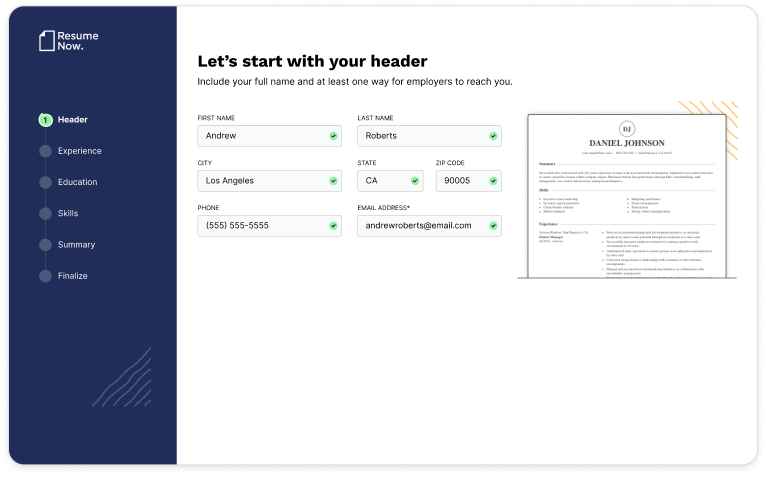
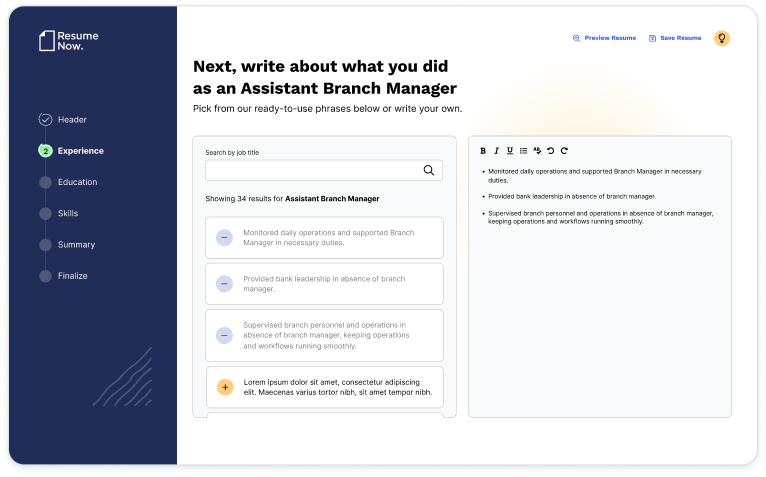
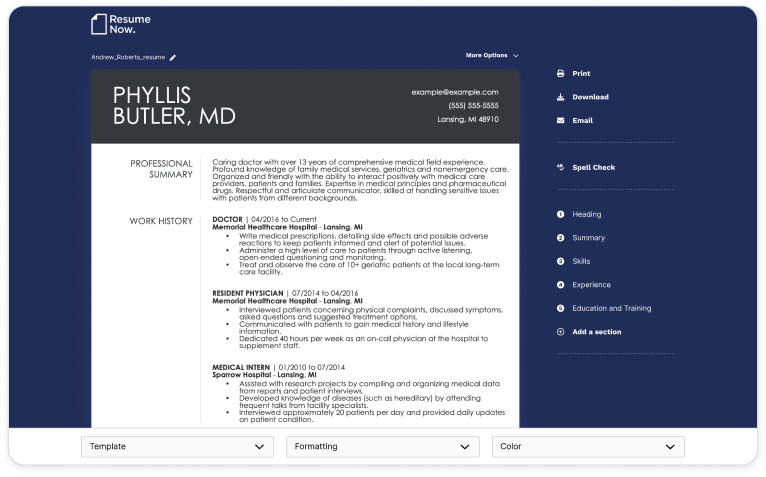
When you're finished, download the file in whichever format you'd like, including PDF and DOCX.
Pair Your CV With a Cover Letter
Now that you know how to write a professional CV, it's time to write a cover letter to accompany it. Writing a cover letter allows you to highlight the most impressive parts of your CV and draw attention to your proudest professional achievements.
When choosing a cover letter template, pick one that matches or closely resembles your CV design to create a polished, cohesive job application.
Pro Tip
Check out our Cover Letter Generator if you're unsure of what to write. Our builder's auto-generated letter content is a great way to avoid staring at a blank page.
Final Thoughts
A strong CV is organized, tailored to the role, and focused on your accomplishments. Use the tips in this guide to create a polished, professional document that clearly communicates your qualifications and helps you stand out to employers.
Frequently Asked Questions
How do I write a good CV?
To write a good CV, tailor your experience, skills, and measurable achievements directly to the role you want. Organizing your work history in reverse-chronological order with clear headings and action-driven verbs makes your background instantly compelling. Keep your formatting clean and consistent, so both recruiters and ATS can easily scan your qualifications. Finally, emphasize your core transferable skills and proofread meticulously before sending off your application.
Do employers prefer a CV or a resume?
It depends. In the United States, most employers prefer a resume for private-sector jobs, while a CV is typically required for positions in academia, research, medicine, and some government roles.
In many other countries, including much of Europe, the term "CV" is used for the document that U.S. employers call a resume. Always follow the employer's application instructions to ensure you submit the correct document.
What are the seven basic steps to writing a CV?
The seven basic steps to writing a CV are:
- Choose a professional CV template.
- Add your contact information.
- Write a strong professional summary.
- List your work experience.
- Include relevant skills.
- Build your education section.
- Add any additional sections, such as certifications, publications, awards, or professional memberships.
Before submitting your CV, proofread it carefully and tailor it to the specific role.
What should you not put on a CV?
Avoid including information that isn't relevant to the job or could distract from your qualifications on your CV. In most cases, you should leave out personal details such as your date of birth, marital status, religion, and political affiliation.
You should also avoid exaggerating your experience, listing outdated or irrelevant skills, including unexplained employment gaps, or submitting a CV with spelling or grammar mistakes. Every section should help demonstrate why you're a strong candidate.
How far back should a CV go?
A CV doesn't have a strict length or time limit. Unlike a resume, which often focuses on the past 10 to 15 years, a CV may include your entire academic and professional history when it's relevant to the position.
If you're creating a CV for academia, research, or medicine, it's common to include earlier experience, publications, presentations, certifications, and other career accomplishments. For other types of CVs, prioritize your most relevant experience and summarize or omit older roles when appropriate.
Should I include a photo on my CV?
In the US, UK, Canada, and Australia, the answer is almost always no. Employers often reject CVs with photos to protect against potential bias and anti-discrimination claims. Additionally, image files can trip up ATS software, preventing your CV from reaching hiring managers.
In parts of Continental Europe, Asia, and Latin America, including a professional headshot remains common or expected practice.
So, unless you're applying in a region or industry (like modeling or acting) where photos are explicitly requested, leave it off your CV.
What are the signs of a bad CV?
Signs of a bad CV include long paragraphs instead of concise bullet points, vague descriptions without measurable achievements, outdated or irrelevant information, and inconsistent formatting. Spelling and grammar mistakes can also leave a negative impression.
Another common issue is submitting the same generic CV for every application instead of tailoring it to the specific role.
Can ChatGPT write a CV?
Yes. ChatGPT can help you write a CV by generating content, improving wording, organizing sections, and tailoring your experience to a job description.
You should always review and personalize the final document to ensure it's accurate, reflects your accomplishments, and matches the position you're applying for. AI works best as a writing assistant rather than a replacement for your own expertise.


Don is a Certified Professional Resume Writer (CPRW) with more than 10 years' experience creating digital content, including four years helping job seekers develop their careers.
More resources

What Is a Curriculum Vitae? CV Meaning & When to Use One
CV stands for curriculum vitae a document that summarizes ...

CV vs Resume: What's the Difference Between the Two
The complete guide to what is a CV (Curriculum Vitae) what a ...

How to Use AI for a CV: Tips, Examples & Sample Prompts
Hoping to build a CV with AI help? We ll help you leverage t...
Workplace AI Temp Check: Washington, DC, Arizona, & Colorado Lead in Business AI Use
Resume Now analyzed AI adoption by state revealing where repo...

What Is an ATS Resume? Definition & How to Write Yours
An ATS resume is a resume formatted to help applicant tracking...

The AI Whelmed Worker: 44% Feel Overwhelmed by the Pressure to Learn & Use AI at Work
Resume Now s new report reveals that workers feel uncertain u...
 Get the job 2x faster*
  Customize your cover letter